
Microsoft Just Dropped the Largest AI-at-Work Study Ever — And the Data Reveals Some Shocking Truths
Microsoft’s 2026 Work Trend Index landed this week, and the raw data behind it tells a far more interesting story than the press release. After analyzing trillions of Microsoft 365 productivity signals, surveying 20,000 workers across 10 countries, and running machine learning models on 29 different factors, the findings paint a picture that should make every corporate leader uncomfortable — and every individual worker think differently about their AI strategy.
We dug into the actual data files Microsoft published. Here are the findings that didn’t make the headlines.
TL;DR
- Nearly half of all AI use at work is for analysis and decision-making — not writing emails or generating code
- Organizational culture matters over 1,000 times more than what industry you work in when it comes to AI impact, per Microsoft’s analysis
- Only 19% of workers operate in the “Frontier zone” where both they and their organization are AI-ready
- Manufacturing leads AI agent adoption at 17.6% — more than software companies at 12.3%
- Manager support is 75 times more important than your job level for getting value from AI
- 50% of all workers are stuck in the “Emergent” zone — not failing, not thriving, just… existing
1. Decision-Making Dominates AI Use — And Nobody Expected This
When Microsoft analyzed more than 100,000 Microsoft 365 Copilot conversations from a single week in February 2026, the results were striking. A full 27.5% of all AI interactions were for “making decisions and solving problems” — nearly three times the share of any other single activity.
The breakdown reveals something unexpected: 49% of all Copilot use falls under “analyzing, reasoning, and deciding.” That’s cognitive heavy lifting. Only 17% is for “producing work” — the content generation that dominates AI marketing narratives.
Think about what this means. The conversation isn’t “write me an email.” It’s “help me figure out what to do.” Workers are treating AI as a thinking partner, not a typing assistant. The second most popular activity? “Getting information” at 13% — people asking AI to find and synthesize data, not just draft it.
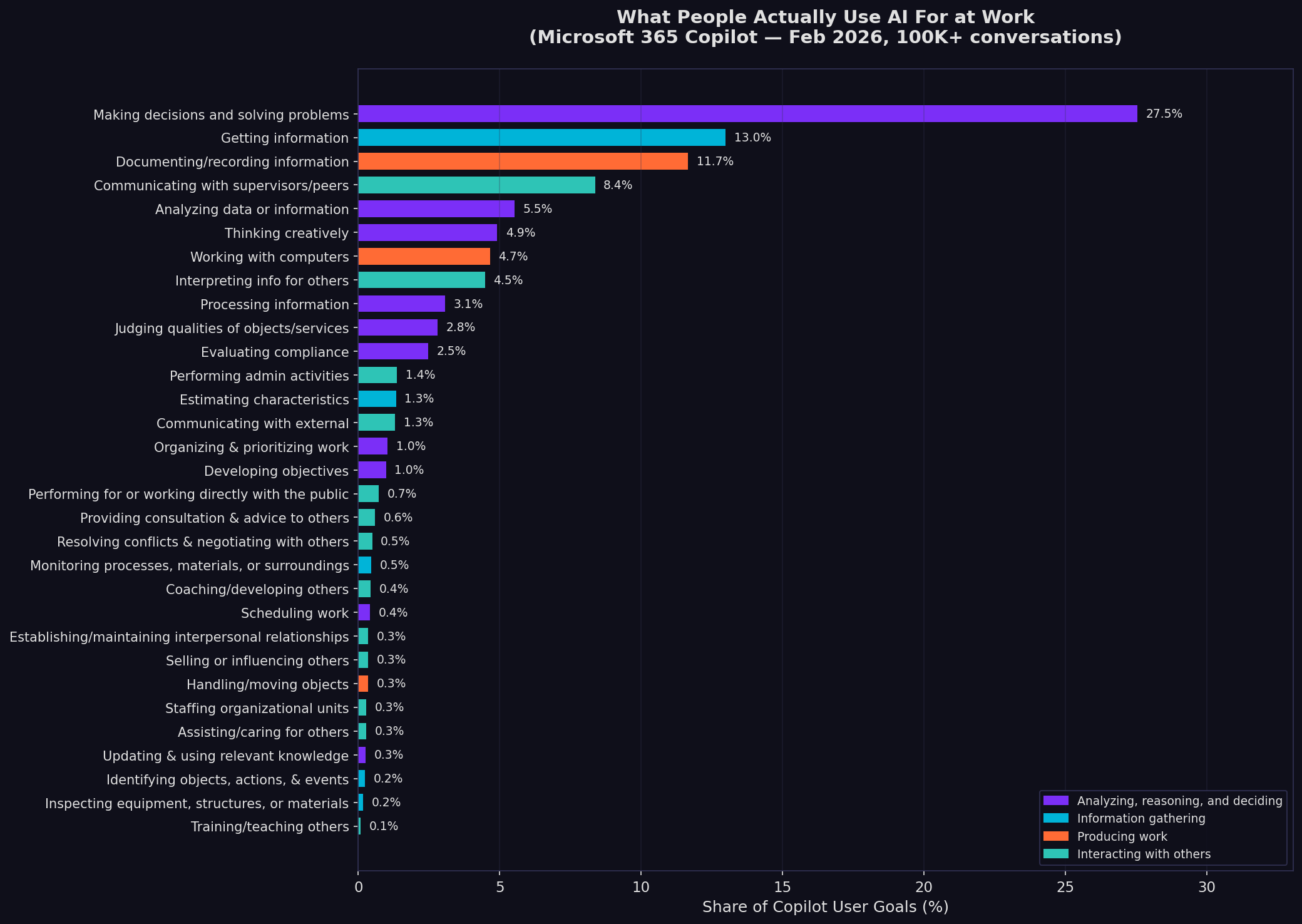
The creative writing use case that launched a thousand think pieces? “Thinking creatively” accounts for just 4.9% of AI use. Documenting and recording information (11.7%) outweighs creative work by more than 2-to-1.
2. Your Company’s Culture Matters 1,048× More Than Your Industry
This is the number that should rearrange every boardroom. Microsoft’s research team ran three different machine learning models (elastic net, random forest, and XGBoost) across 29 factors to find what actually predicts whether workers get real value from AI.
The answer isn’t individual talent. It isn’t what industry you’re in. It isn’t your job level, your generation, or your company’s size.
It’s organizational culture.
“Org AI culture” — whether the company is open and curious about AI, whether it feels safe to suggest new ways of working with AI — came in as the #1 predictor with a raw importance score of 0.1048. The entire demographics category combined (industry, job level, generation, company size, market, tenure, decision-maker status, AI familiarity, job function) added up to just 0.0094.
That means organizational culture alone is 1,048 times more impactful than industry when it comes to workers actually benefiting from AI. Not 2×. Not 10×. Over a thousand times.
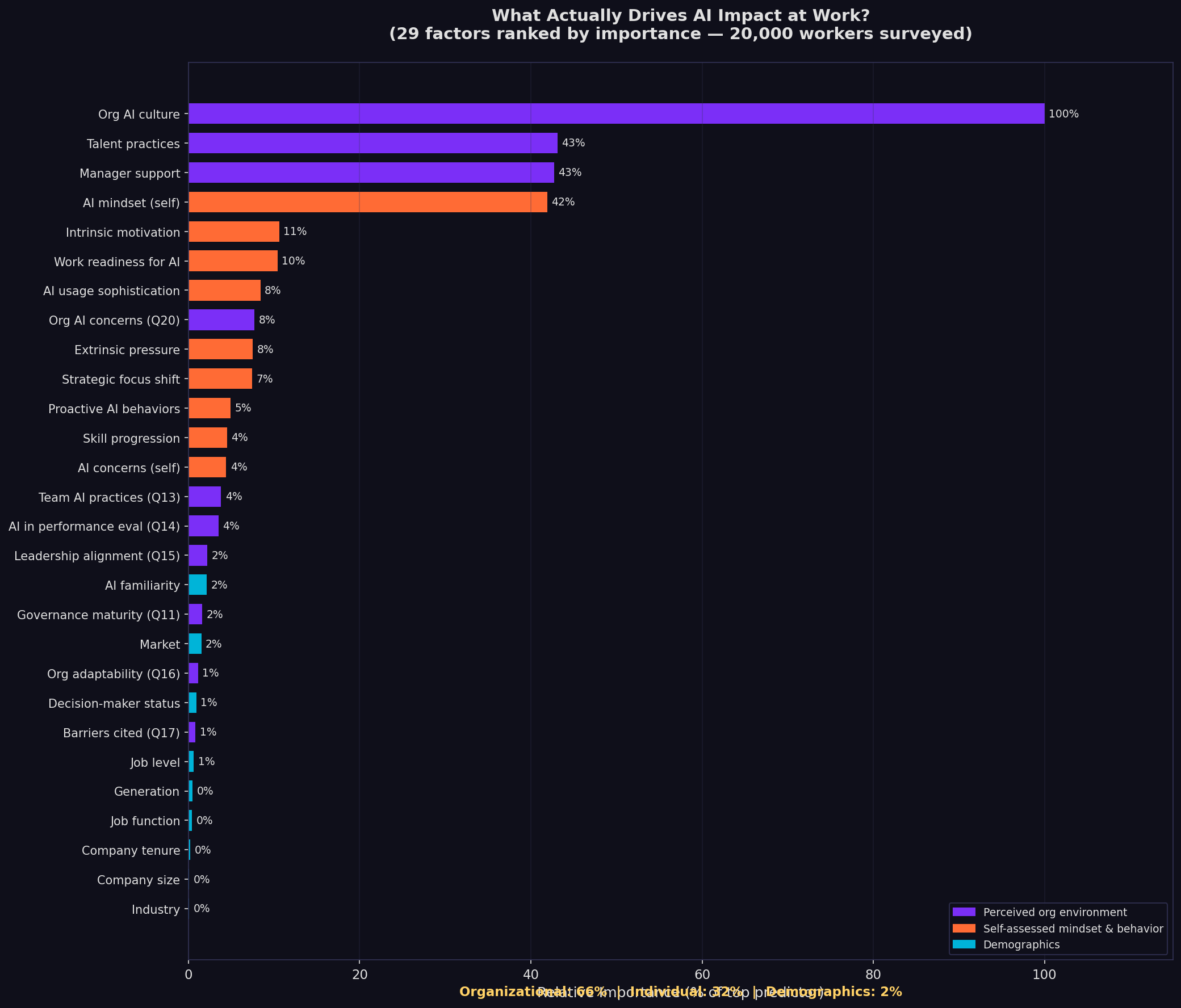
The top three predictors are all organizational: AI culture (100%), talent practices (43.1%), and manager support (42.7%). The best individual factor — your own AI mindset — ranks fourth at 41.9%.
In total, organizational factors account for 66% of AI impact. Individual mindset and behavior account for 32%. Demographics? Just 2%.
The implication is brutal: you can hire the most AI-savvy people on earth, but if your culture doesn’t support AI experimentation, you’re wasting most of their potential.
3. The Manager Effect: 75× More Important Than Your Job Title
Here’s a stat that should rewire how every company thinks about AI training. Manager support has a raw importance of 0.0448. Job level? 0.0006.
Your manager’s willingness to model AI use, encourage experimentation, and make it safe to try new things is 75 times more important than your position in the corporate hierarchy.
A separate Microsoft study of 1,800 workers found that when managers actively model AI use, employees report a 17-point lift in AI value, a 22-point lift in critical thinking about AI, and a 30-point lift in trust in agentic AI. When managers create psychological safety around AI experimentation, employees are 1.4× more likely to be high-frequency users of agentic AI.
The fix isn’t more training courses. It’s getting managers to use AI themselves — visibly, consistently, and with the same vulnerability as everyone else.
4. Half the Workforce Is Stuck in Neutral
Microsoft mapped 20,000 workers across two dimensions: their individual AI capability and their organization’s readiness. The resulting five zones tell a story most companies don’t want to hear.
Only 19% of workers are in the “Frontier” — where both individual capability and organizational readiness are high. These are the people actually getting transformative value from AI.
10% are in “Blocked Agency” — they’ve built strong AI skills, but their organization hasn’t caught up. These are your most frustrated employees, the ones most likely to leave.
16% are “Stalled” — low capability, low organizational support. They’re barely in the game.
5% sit in “Unclaimed Capacity” — the organization is ready, but these workers haven’t developed the skills yet. This is the easiest group to fix.
And then there’s the big one: 50% of all workers are “Emergent” — both individual practice and organizational conditions are taking shape but haven’t clicked yet. This is where the war is won or lost.
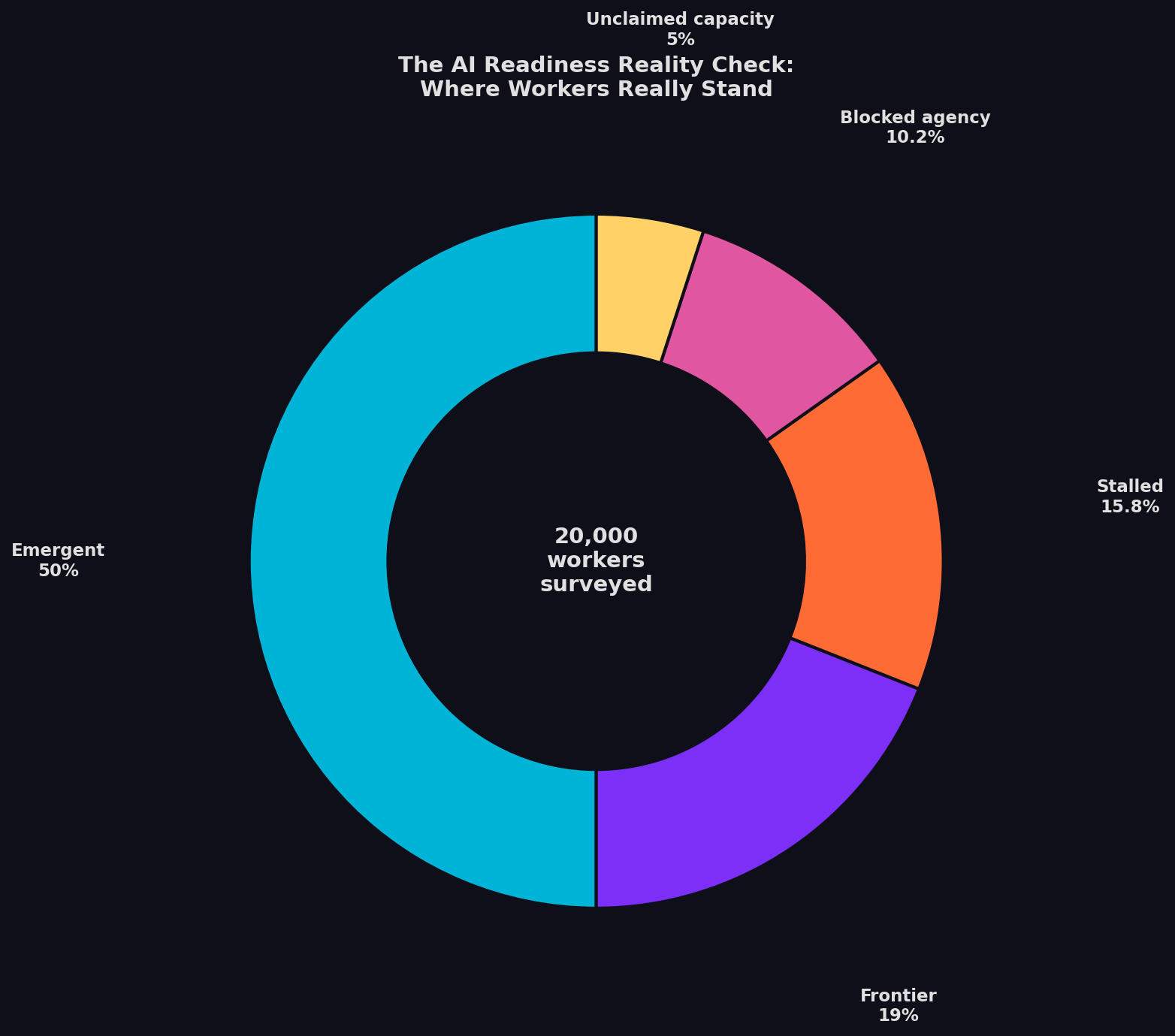
The median organizational readiness score is 0.635 (just above the midpoint). The median individual capability score is 0.427 — below the midpoint. Organizations are slightly ahead of their people, but neither is where it needs to be.
5. Manufacturing Leads AI Agent Adoption — Not Tech
When Microsoft mapped AI agent adoption by industry, the results challenged every Silicon Valley assumption.
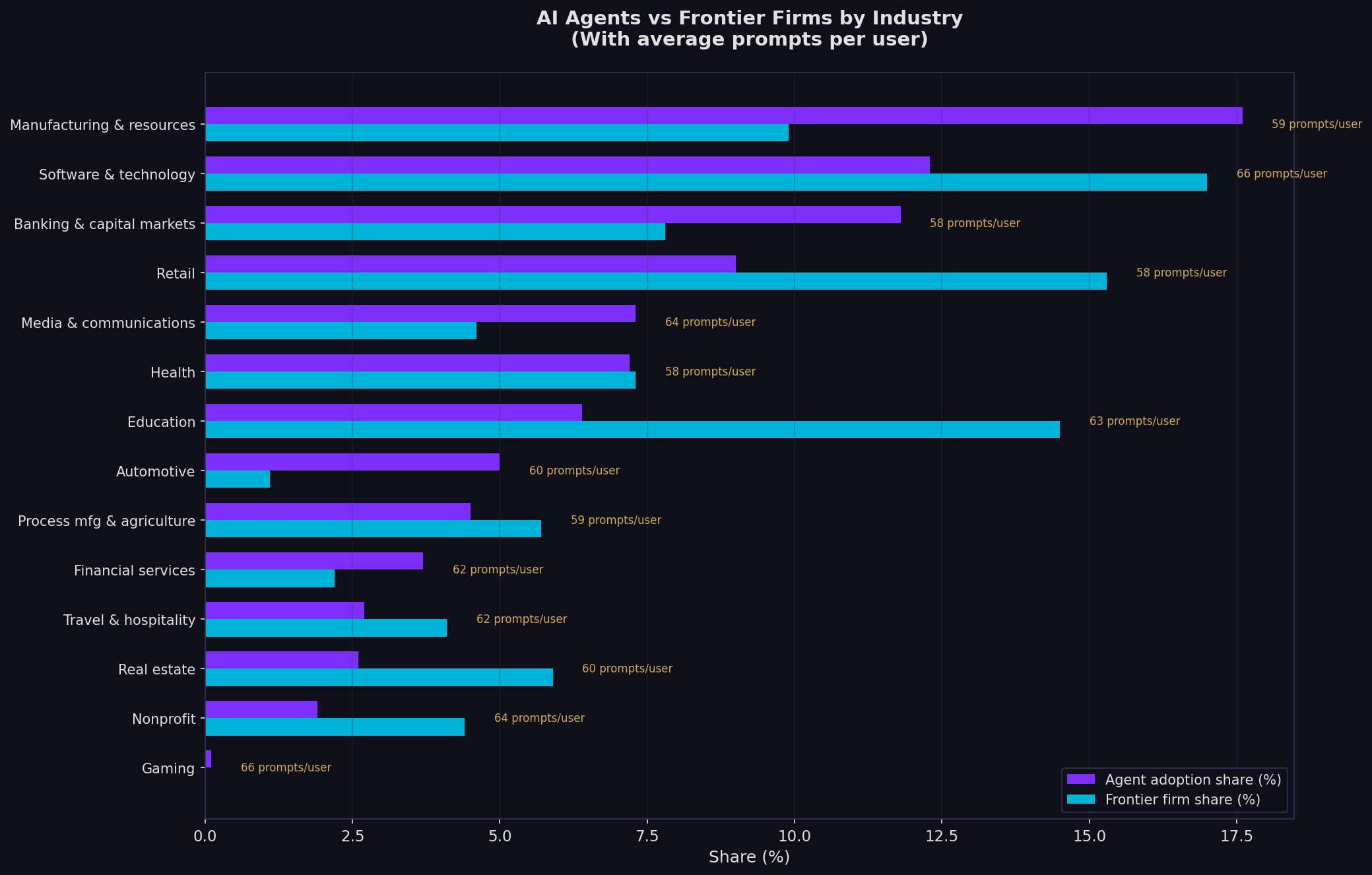
Manufacturing & resources leads at 17.6% agent adoption share — significantly ahead of software & technology at 12.3% and banking & capital markets at 11.8%.
But here’s the twist: when it comes to “Frontier firm” status (organizations where both capability and readiness are high), software leads at 17.0%, followed by retail at 15.3% and education at 14.5%.
Manufacturing has the agents. Software has the organizations.
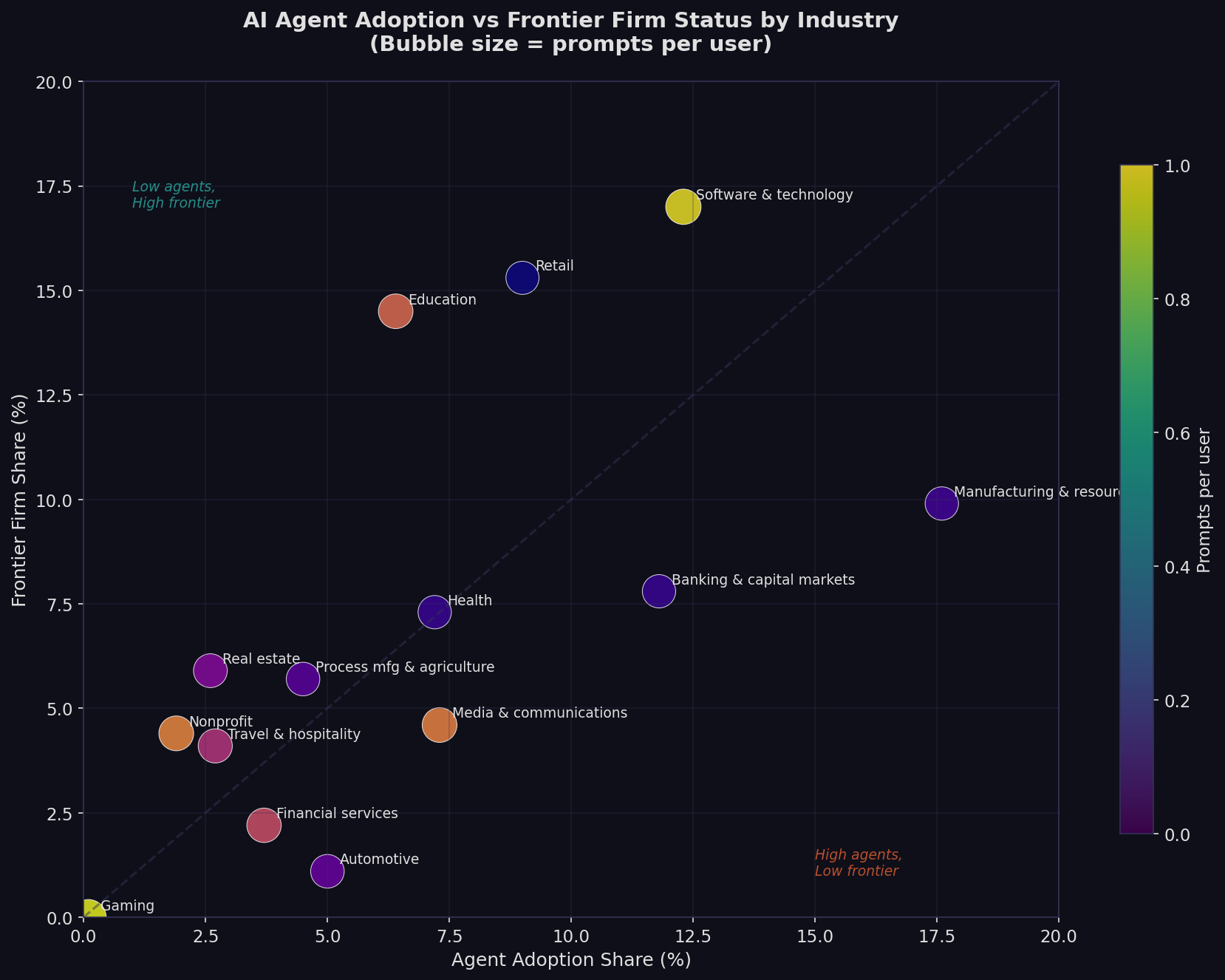
The industries with the biggest gap between agent adoption and frontier firm status? Education (6.4% agent share, 14.5% frontier firm share — an 8.1-point gap) and retail (9.0% vs. 15.3% — a 6.3-point gap). These industries have organizational readiness but haven’t deployed agents at scale yet.
Meanwhile, manufacturing has the reverse problem: 17.6% agent adoption but only 9.9% frontier firm share. They bought the tools without building the culture.
6. Gaming Workers Use AI the Most per Person
The industry data holds one more surprise. When it comes to prompts per user, gaming leads at 66.0 per period, followed by software & technology at 65.7 and nonprofit at 63.8.
The industries with the fewest prompts per user? Banking and healthcare, both at 58.5, and retail at 57.8.
Gaming has near-zero frontier firm share (0.0%) and the lowest agent adoption (0.1%), but individual users who do engage with AI are power users. This suggests gaming workers are experimenting intensely with AI but in organizations that haven’t institutionalized it.
7. The Transformation Paradox: 65% Fear Falling Behind, 45% Fear Changing
The survey reveals a cognitive dissonance that explains why so many organizations are stuck. 65% of AI users fear falling behind if they don’t use AI to adapt quickly. Yet 45% say it feels safer to focus on current goals than to redesign work with AI.
Only 13% of AI users say they’re rewarded for reinventing work with AI — even when results aren’t met. Only 26% say their leadership is clearly and consistently aligned on AI.
Workers want to change. The system punishes change. The system wins.
This is what Microsoft calls the “Transformation Paradox,” and it explains the 50% “Emergent” zone perfectly. Half the workforce lives in the gap between wanting to transform and being structurally prevented from doing so.
8. Frontier Professionals Deliberately Work Without AI
Perhaps the most counterintuitive finding: the most advanced AI users are the ones most likely to intentionally work without it.
43% of Frontier Professionals say they deliberately do some work without AI to keep their skills sharp (vs. 30% of non-Frontier). 53% intentionally pause before starting work to decide what should be done by AI versus a human (vs. 33%).
Frontier Professionals — who represent just 16% of AI users — rank higher on every measure of critical thinking and quality control. They don’t use AI to outsource thinking. They use it to amplify judgment.
80% of Frontier Professionals say they’re producing work they couldn’t have a year ago. But they refuse to let their core skills atrophy in the process.
Why This Matters
Microsoft’s 2026 Work Trend Index is ultimately a story about a massive misalignment between human potential and organizational architecture. The data is unambiguous: the biggest lever for AI impact isn’t better tools, smarter individuals, or picking the right industry. It’s building a culture where AI experimentation is safe, expected, and rewarded.
The 19% of workers in the Frontier aren’t better people. They work in better systems. The 10% in Blocked Agency aren’t less capable — they’re in worse organizations.
For leaders, the prescription is clear: stop optimizing for AI adoption and start optimizing for AI absorption. The difference matters. Adoption is buying tools. Absorption is redesigning work, realigning incentives, and making it psychologically safe to experiment.
For individuals, the message is equally clear: your AI impact depends less on your skills and more on your environment. If your company doesn’t support AI use, no amount of personal upskilling will close the gap. The single most impactful career move might not be learning another AI tool — it might be finding an organization that’s actually built to use the ones you already know.
The raw data tells a story that the polished report softens: we’re not in an AI adoption crisis. We’re in an organizational architecture crisis. The technology is ready. The people are mostly ready. The systems between them are not.
Source: Microsoft 2026 Work Trend Index. Analysis based on survey data from 20,000 workers across 10 countries (US, BR, AU, IN, JP, FR, DE, IT, NL, UK), fielded February–April 2026 by Edelman Data x Intelligence. Copilot activity data from anonymized Microsoft 365 telemetry, one week in February 2026. Predictor analysis uses random forest permutation importance across 29 factors. Full data available at Microsoft WorkLab.
The views and analysis expressed in this article are those of the author and do not constitute financial or investment advice. Past trends do not guarantee future results.
manufacturing leading AI adoption makes perfect sense – data rich environments
Bear markets are for building — and builders are delivering
The pace of innovation in crypto continues to surprise me
the 1048x culture multiplier is a mind-blowing stat from microsoft
this study has massive implications for how crypto projects should think about adoption
The best projects are the ones quietly shipping during bear markets
manufacturing at 17.6% AI adoption beating software companies at 12.3% is wild. factories have real data pipelines, tech companies drown in Notion docs
culture matters 1048x more than industry is the kind of stat consultants will quote for a decade and nobody will actually act on
Bear markets are for building — and builders are delivering
culture matters 1048x more than industry is a stat that will haunt every consultant deck for the next decade. but nobody will actually do anything about it because culture is hard to measure and harder to change
Pia H. 19% in the frontier zone means 81% of workers are either ahead of their org or behind it. that misalignment cost has to be in the trillions annually
1048x multiplier on culture is insane until you realize most companies with ‘AI initiatives’ still have managers who cant use Excel properly
Tobias R. 1048x multiplier on culture vs industry is the kind of stat that sounds absurd until you work at a company where middle management still prints emails. culture eats strategy for breakfast, AI included
manufacturing at 17.6% AI adoption beating software companies at 12.3% is the most underrated stat in this whole study. factories actually have data pipelines that work, tech companies are drowning in notion docs
ml_ops_grinder manufacturing beating software at AI adoption makes sense when you realize factories already have sensors measuring everything. SaaS companies have dashboards measuring nothing useful
the notion docs point is funny because its true. SaaS companies have dashboards tracking vanity metrics. factories have sensors measuring actual throughput. no wonder AI adoption is higher
dashboards_zero_ 100%. every saas company i contracted at had 15 Looker dashboards nobody opened. factories measure oee and downtime because money is literally on the line every minute
manufacturing beating software at 17.6% vs 12.3% makes total sense. factory floors already measure everything, SaaS companies just have vanity dashboards
1048x variance between cultures is wild. would love to see the breakdown by team size too. my guess is small teams in any culture adopt faster
19 percent in the frontier zone means 81 percent of the workforce is misaligned in some direction. microsoft surveyed 20k people across 10 countries to basically prove that most orgs are not ready
manufacturing leading AI adoption makes sense when you realize how much data shop floor sensors generate. its not creative work, its pattern matching at scale
Yara M. factory sensors generate structured time series data. SaaS companies generate unstructured Notion docs. AI eats the first one for breakfast and chokes on the second
the 1048x culture multiplier is insane but makes sense. ive seen factories with 40 year old ERP systems out-innovate saas startups because the floor workers actually trust the ai suggestions
19% frontier zone is brutal. means 4 out of 5 companies are paying for copilot licenses and getting nothing back because managers wont change how meetings work
19% frontier zone means 81% of orgs bought AI tooling with zero plan to use it. thats trillions in wasted licenses. Microsoft basically printed money selling Copilot seats nobody uses